


After years of very severe Crohn’s disease, 6 Tylenol a day, 6 different immunosuppressant drugs (being on two at the same time at one point), going through rounds of quadruple antibiotic therapy - yes, you heard that right- C. diff infections, tons of oral steroids, and more therapies and pharma drugs than I can keep track of, my liver had reached its breaking point.
After losing my colon to a botched colonoscopy by a medical student, my skin slowly started breaking out, and not just breaking out, but developing deeply scarring, tunneling acne-like lesions on my face and back.
At this point, I was well-versed in health, doing everything I was supposed to do, yet my skin just wouldn’t calm down. It continued to head in the wrong direction, to the point where I was seeing my dermatologist once a week for steroid injections to manage the pain.
My skin was so painful, I barely slept at night.
Ultimately, I hit a eureka moment after my labs continuously came back normal except bilirubin and alkaline phosphatase, which led me to look further back in my labs, revealing 10 years of chronically high liver enzymes.
I always tell people, “If you have skin issues, check the liver.” Why? The body has four main means of excreting toxins: the liver, the gut, the kidneys, and the skin. Oftentimes, when one is overwhelmed, the others suffer, especially the skin.
It’s almost like a clogged toilet; that junk’s gotta go somewhere, so it overflows into the skin.
A hair tissue mineral analysis later confirmed this theory for me, as I had a mercury, nickel, arsenic, and aluminum burden.
I never tested any other toxins, but with my liver offline for many years, I probably was full of things like glyphosate, mycotoxins, PFAS, BPA, etc., as my detox pathways shut down, leading to a continual burden and lack of excretion.

What is Bile?
Before we can even get into toxin load and its effect on the liver, we first need to understand bile.
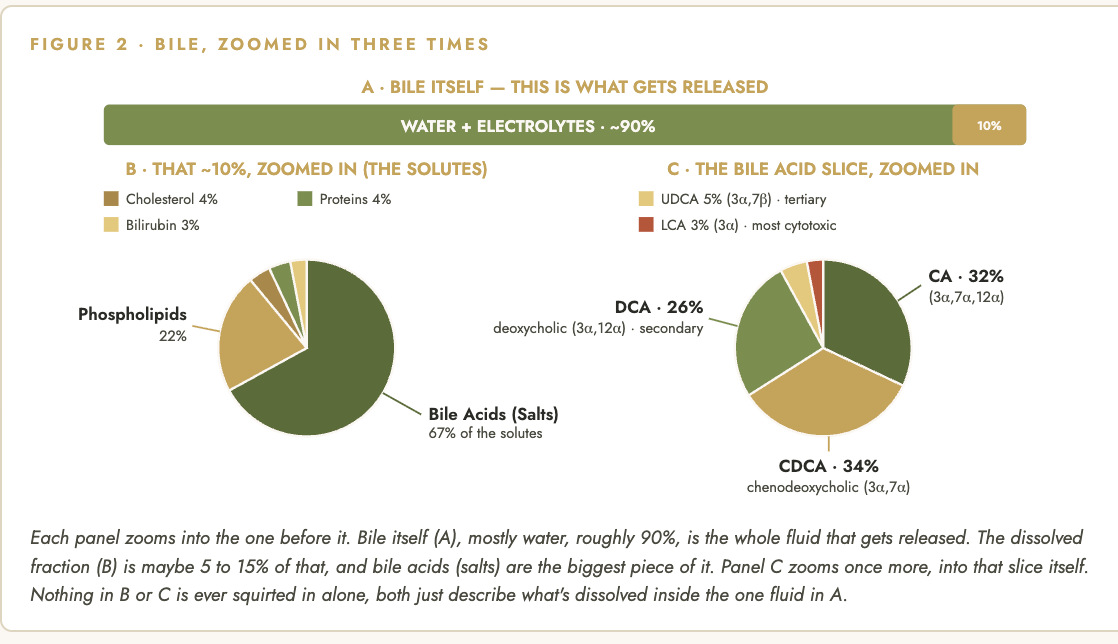
Bile is a watery, alkaline, green fluid made mostly of water, synthesized from cells in the liver called hepatocytes, which make roughly 800-1000ml of bile a day, with ~90% of that being water.
The remaining 10% is broken down into:
22% Phospholipids
67% Bile Acids (a steroid molecule made from cholesterol)
4% Cholesterol
4% Protein
3% Bilirubin (old red blood cells; also what gives bile the green pigment)
It’s stored in the gallbladder in its concentrated form, sometimes up to 10x the strength, in around 30 to 80 milliliters of volume, and released through a hormone called cholecystokinin (CCK), which is triggered mainly by fats and proteins reaching the duodenum, and also by stomach acid hitting it.1
CCK literally means “to move the bile sac.” It squeezes bile out of the gallbladder directly onto food, while also relaxing the smooth muscle of the sphincter of Oddi, gating the junction where the common bile duct and pancreatic duct meet the duodenum.
The gallbladder’s proximity to the stomach and bile’s alkalinity help neutralize the acidic chyme (partly digested food) coming from the stomach and traveling into the duodenum.
This also provides an immediate source of concentrated bile right as fat enters the duodenum, as the components in bile are responsible for emulsifying fats.
Those components are called bile salts, which are the conjugated form of bile acids; the body attaches an amino acid, either taurine or glycine, to the raw bile acids, creating a bile salt.
These bile acids start as excess cholesterol your body needs to excrete; bile is the body’s main means for excreting excess cholesterol2.
The liver builds two “primary” bile acids from cholesterol via an enzyme called CYP7A1. These two bile acids, cholic acid (CA) and chenodeoxycholic acid (CDCA), are still too weak to be utilized; they irritate the gut lining and don’t dissolve well in water (hydrophobic).
This is why the liver conjugates them, which results in them becoming ionized: the process of losing a proton gives them a negative charge, making them water-soluble and far less likely to pass through the gut lining, getting reabsorbed, and failing to do their job.
Conjugation
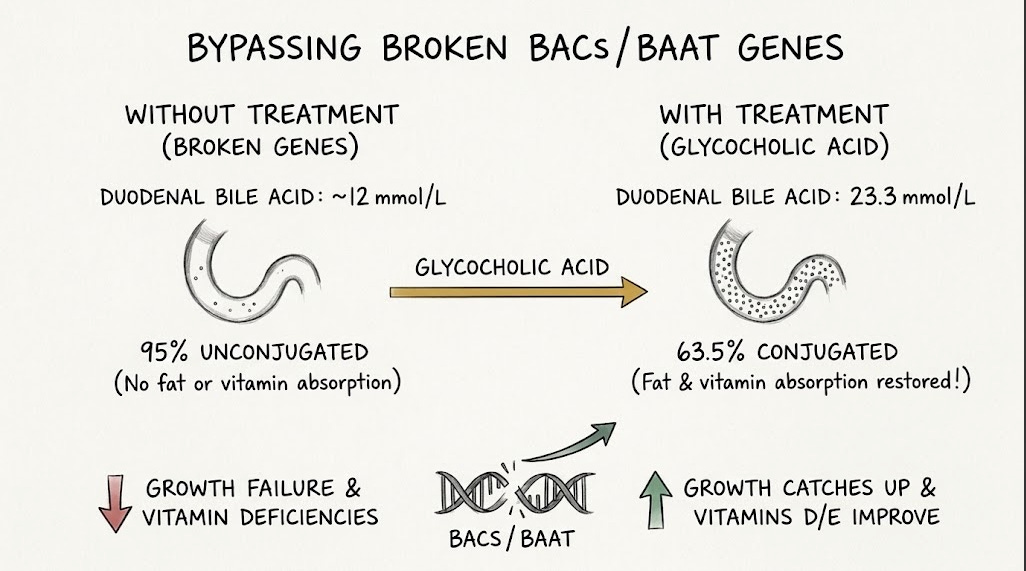
Bile acid conjugation is so important that ten children born with broken BACS or BAAT genes, the same genes that conjugate bile acids into bile salts, had considerable ailments such as fat-soluble vitamin deficiency, growth failure in some, and in a few cases, newborn liver disease.3
These kids had bile acid concentrations around 12 mmol/l in their duodenum, far too low for fat absorption, and 95% were not conjugated.
The same children were then treated with glycocholic acid, the conjugated form of cholic acid and glycine, effectively bypassing the broken BACS/BAAT enzyme entirely.
Duodenal bile acid concentration rose to 23.3 mmol/l, with 63.5% of the bile acids conjugated; oral fat-soluble vitamin absorption improved, as patients were given Vitamin D and E, and growth caught up in the 3/3 children who had fallen behind. 4
When bile acids are conjugated, they help form micelles, which help break down fat and act as packaging systems for transport and absorption of this fat, hence the enhanced nutrient absorption for these kids when given glycocholic acid.
Moreover, a study with patients recovering from hepatobiliary surgery, surgery on the bile ducts, had tubes placed in their bile ducts to measure bile directly. Post op, these patients were given a diet with added taurine and showed a doubling of bile acid concentration from 4.7 to 8.9 mg/ml after 10 days.
Taurocholic acid, cholic acid plus taurine, went from 0.5 to 1.1 mg/mL and taurochenodeoxycholic acid from 0.3 to 1.0. The glycine conjugates rose too: glycocholic from 1.9 to 3.5, glycochenodeoxycholic from 1.4 to 2.6.
Lastly, obese folks, who typically run low in glycine, were given 100mg per kg of glycine for two weeks. Plasma glycine rose, urinary metabolites that measure glycine conjugation rose, and triglycerides and liver enzymes dropped as well.5
Point being, conjugation is huge for optimizing bile, and therefore so is providing the raw elements needed, like taurine and glycine.
Increasing either amino acid is a fantastic strategy for optimizing liver health.
The Pumps
Recently I was listening to Dr. Chris Shade, founder of Quicksilver Scientific and someone I consider a mentor for much of my coaching work, and something he said that stuck with me was, “toxin transporters and bile transporters are the same thing.”
The bile salt export pump (BSEP), the main pump that drives bile salts out of the liver cell and into bile, and multidrug resistance protein 2 (MRP2), BSEP’s partner pump that pushes toxin conjugates into bile, are the two main workhorses of bile flow.
Essentially, those pumps push bile and are also the guys helping your cells push toxins out, which tells you the importance of optimizing bile flow.
BSEP and MRP2 pumps are like the trash guys: they take the trash out of your trashcan and drive it to the dump. BSEP literally pushes bile salts out of hepatocytes and into the bile ducts, while MRP2 drops the conjugated toxins into bile.
When BSEP is damaged by drugs, estrogen, toxins, or totally missing because of a genetic mutation, it can lead to “an accumulation of bile salts within hepatocytes, where bile salts become cytotoxic. If persistent, accumulation of bile salts in hepatocytes will lead to liver disease.”6
At that point, it’s like an overflowing toilet, except what is backed up is harsh enough to eat away at the toilet itself.
MRP2 is critical in Phase III detox. It recognizes toxins that are conjugated from Phase II, when toxins are tagged with molecules like glutathione for excretion, and pumps them out of the cell into bile.
Alongside living in the liver cells, it is found in your kidney cells, gut lining, and even the placenta, which helps keep a baby safe from a toxic burden.
These pumps are the driving forces behind bile flow and toxin excretion, and without them functioning, the bile sits in the liver with nowhere to go, stewing in its own filth.
So what slows down bile?
Modern Toxins Hate Your Liver
If you are a living, breathing human being in 2026, you are exposed to toxins on a daily basis. Since WWII, approximately 80,000 chemicals have been introduced into the environment, while 1,500 new chemicals are being added every year.7
When I explain toxicity to people, I explain the three main categories: heavy metals, mold, and glyphosate. I then explain glyphosate as an umbrella category (because everyone recognizes its name) that includes glyphosate itself and those 80,000 different chemicals, like PFAS (forever chemicals), plastics, and varying herbicides and pesticides.
What organ largely has to process these toxins? Your liver. And what carries much of these toxins out? Bile. This is why I obsess over liver and bile optimization with my clients.
It’s also why clients who take the liver portion of my program to heart make insane gains with their health issues, like reversing chronic constipation in 5 days (testimonial on my website), and losing almost 50 pounds of inflammation weight from mold in 5 months.
Toxicity gets a bad name in the alternative health space. I can’t stand the cringe “dEtOX” influencers on social media, who hand out elementary school guidance on toxicity and flat-out harmful advice.
Like people telling you that you can detox heavy metals utilizing chlorella and cilantro, which are some of the weakest and most worthless “chelators” out there.
I have had clients come to me after their naturopath put them on chlorella for severe mold toxicity, only for them to get worse over 4 months. Just like that, 4 months of your life wasted on poor guidance. It’s the equivalent of handing someone with gut issues a giant bottle of oregano and telling them to just chug away to fix their gut issues.
Rant over and back to the science; point being, toxicity is a fact of the 21st century. I want to focus on heavy metals for this article, and what the research says on how heavy metals affect the liver.
Heavy Metals:
A US national survey measured cadmium in the urine of 12,732 adults. Men in the top quarter of cadmium toxicity had more than two times the odds of hepatic necroinflammation (the rate of liver cell death and inflammation), and nearly double the rate of fatty liver. This was after adjusting for smoking, which is a risk factor for cadmium toxicity. Then, between both men and women, “individuals in the top quartile of creatinine-corrected urinary cadmium had over a threefold increased risk of liver disease mortality.”8
Non-alcoholic fatty liver disease was always associated with being obese, yet the research is starting to implicate toxicity as a major driver. In a study of 2,500 people with fatty liver, those with the highest blood lead levels had ~6x the odds of advanced liver fibrosis, the most severe stage of scarring short of cirrhosis, whether they were obese or not.9
A study examined mercury in the blood of 872 pregnant women across several European countries. Researchers wanted to see how prenatal mercury exposure affected childhood liver injury. After checking in on the kids 8 years later, higher prenatal mercury tracked with elevated ALT (one of the best measures for liver damage) and raised inflammatory cytokines like IL-1β, IL-6, IL-8, and TNF-α. They then took human immune cells, monocytes, exposed them to mercury in a petri dish, and found the same inflammatory cytokine genes flipped on. Side note, but it’s funny how they make immunosuppressant drugs (I took 6 different ones) targeting these exact inflammatory cytokines in autoimmune patients, yet fail to bring up triggers like mercury, or gaslight you into thinking it’s irrelevant.10
Another mercury study tested 37 different environmental chemicals and their relationship with ALT. Of the 37 chemicals, mercury, alongside non-dioxin-like PCBs, a chemical involved in many manufacturing processes (was even found in the Arctic), accounted for 78% of the liver injury. 11
Researchers looking into arsenic as a potential contributor to non-alcoholic fatty liver studied 8,518 people aged 12 and up (children with fatty liver, yikes). Measuring inorganic arsenic in urine, they found those in the top quarter of urinary arsenic had 40% higher odds of elevated ALT than the bottom quarter. They concluded with a positive association between urinary arsenic exposure and risk of NAFLD.12
It’s not that crazy to implicate toxic metals as a major component in liver issues. Yet, how many doctors are neglecting their oath and not keeping up on this research? More attention should be brought to these topics!
If you’re dealing with gut issues, autoimmunity, or fatigue that won’t budge, hidden triggers like heavy metals may be worth a closer look.
Come read my story, see if it sounds familiar, and book a free consult. It costs you nothing but 20 minutes. Visit littlewaycoach.com to book your consult!
The Liver Damage Mechanism
When it comes to metal toxicity, the liver is numero uno on the battlefield. Anatomically speaking, the liver sees a high concentration of these toxins as they are absorbed in the gut and sends them directly to the liver via the portal vein.
The liver also sees everything floating around in the blood, filtering about 500 gallons of blood per day.
One way or another, toxins make it to the body’s built-in filter.
Take cadmium-induced hepatotoxicity, for example, which can occur by two pathways: the initial damage caused directly by cadmium and/or the subsequent injury due to inflammation.
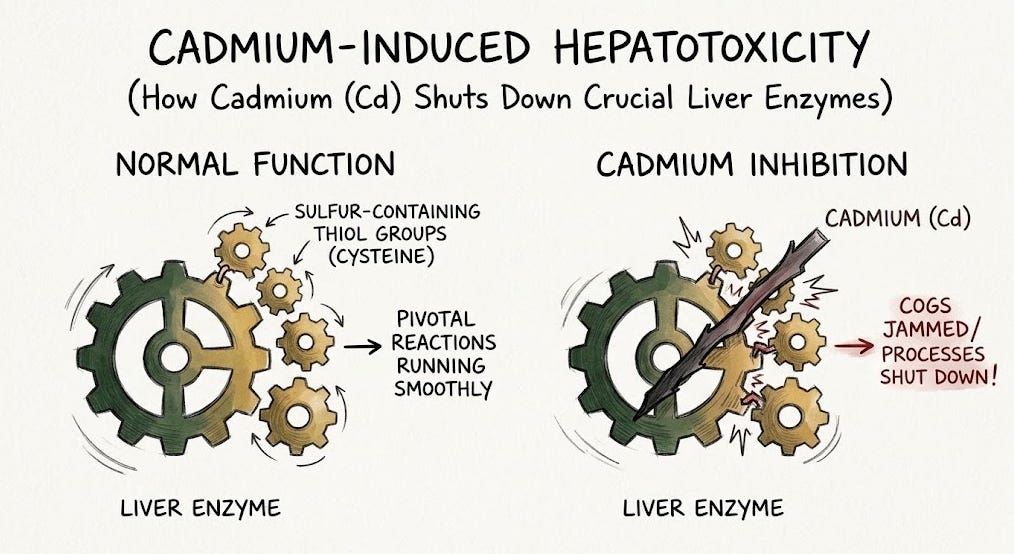
Part of this damage is due to cadmium’s affinity for sulfur. Many enzymes rely on the sulfur-containing thiol groups of the amino acid cysteine to function. These thiol groups act like cogs in a wheel, setting other reactions in motion.
Cadmium binds to these sites and shuts them down. It’s like that meme of the guy riding his bike and then sticking a stick in the front wheel. Cadmium is really inhibiting pivotal processes by doing this.
Take glutathione, for example: a key thiol-based binder of heavy metals, and a tripeptide of cysteine, glutamate, and glycine. Its sulfur grabs metals, but its primary function is dealing with reactive oxygen species.
The mitochondria will often pull glutathione from the cytoplasm of the cell into themselves in order to deal with ROS. This is part of how cadmium harms the mitochondria, by robbing them of their antioxidant support.
From this ROS, energy production collapses; mitochondrial membranes lose integrity, and the cell enters apoptosis (programmed death). This is the first mechanism.
The second mechanism involves the immune system’s reaction to the dead cell, which spills debris and alarms the immune system. The liver’s resident immune macrophage cells, Kupffer cells, detect the spill, recruit neutrophils, and cause an ensuing wave of inflammatory injury.13
This mechanism is also shared by other metals and toxins, and is identical to the childhood mercury study above. Children whose mothers had mercury whilst pregnant had higher markers of liver injury and inflammatory cytokines.
Or take another study I referenced in my last heavy metal article, which showed liver injury and inflammatory markers rising higher and higher over a three- to six-year period. These participants showed a dose-dependent relationship between heavy metal toxicity and higher ALT.14
The study painted the same picture: metals cause an initial inflammatory reaction and then a subsequent immune reaction, creating further inflammatory damage.
Bind sulfur-based thiols needed for enzymatic reactions, trigger mitochondrial cell death, immune system freaks out from damage and launches an inflammatory cascade.
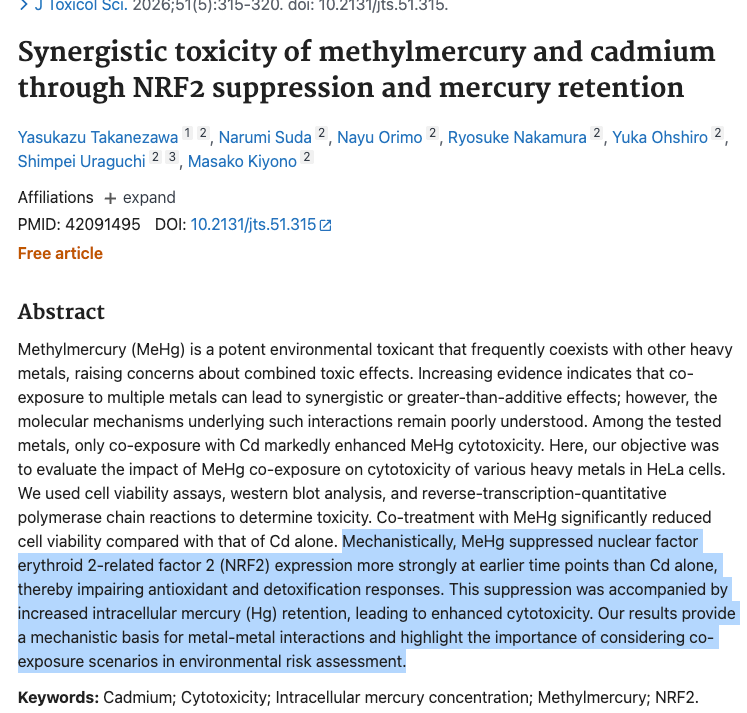
On top of that, Nrf2, our master detox switch, turns on over 200 antioxidant and detox genes, including the ones for glutathione synthesis. Methylmercury has been shown to suppress Nrf2, and when cadmium is in the mix too, the combined toxicity goes up sharply.15
There are tons of other ways metals affect your physiology, but one could easily see how this bleeds into autoimmunity, chronic gut issues, skin issues, and the like.
The initial inflammatory reaction, followed by an ever alert immune system gung-ho on blasting stuff. This is the logical thesis behind autoimmunity: your body isn’t attacking itself, it’s reacting to something, trying to protect itself.
It’s also interesting how various toxins exhibit the same effects on the liver and immune system. Mycotoxins like ochratoxin A have an almost identical mechanism for harming the liver, another reasons toxins often show up together.
I was loaded with metals, but like I said, I bet I was full of plenty of other things too.
Sludgy Bile
Alright, so metals cook the liver, so what does that have to do with me harping on bile in the beginning?
Bile has everything to do with the liver and heavy metals; bile is the liver’s means of excreting these toxins and protecting the liver from that nasty inflammatory feedback loop.
It’s also worth noting there are tons of other factors involved in a successful heavy metal detox, which I am not going to go into here, like mineral balancing, Nrf2 upregulation, cell membranes, metal conjugation, etc., and instead focus on the liver and bile.
Certain metals leave the liver as glutathione conjugates. The liver slaps a glutathione molecule onto a metal, making it easier to excrete. Those bile pumps we talked about earlier, like MRP2 and BSEP, recognize these conjugated toxins and push them into bile.
Metals like copper, zinc, cadmium, mercury, arsenic, and lead are involved in the biliary glutathione excretion via these toxin conjugate pumps.16 17
On top of conjugating toxins, glutathione is also responsible for bile flow, whereby roughly half of bile flow is “bile-acid-independent”, meaning the portion of bile not driven by the osmotic effects of bile acids, and where glutathione acts as an osmotic driver in its stead.
This is evidenced by a study where mice given glutathione infusions directly had a dose-dependent choleresis (when bile flow is increased) response, aka bile started flowing when they added some glutathione in the mix.18
This ties into how bile flow gets clogged via heavy metals:
Mercury lowers glutathione directly and through conjugation. Mice given inorganic mercury had a 50% reduction in glutathione, alongside cysteine (one of the three amino acids that make up glutathione).19
The inflammation from heavy metals shuts down the hepatic bile pumps like MRP2s, BSEPs, MRP3s, etc. Once again, think back to those studies linking heavy metals to higher inflammatory cytokines and the ensuing damage to liver tissue. “Cholestasis occurs during inflammatory conditions characterized by the release of cytokines, particularly interleukin-6 (IL-6), which plays a significant role in the hepatic acute-phase response.”20
Rat livers exposed to cadmium at varying doses. At 10 µM, bile flow slowed; at 100 µM, full cholestasis was reached, so there was no bile flow within 60 minutes; this was also while less than 10% of liver cells had died.21
Similarly, rat livers dosed with mercury, cadmium, and copper showed: liver cells went hypoxic, less fluid was able to flow through cells, a sign of tissue swelling and fluid retention, and cell membranes were damaged. One of the most pronounced effects was the drop in ATP production from mercury and cadmium in the mitochondria.22
Conclusion
The gut gets all the attention, but the liver often sits upstream of gut, thyroid, and skin issues. I learned that the hard way: ten years of high liver enzymes sat in my labs while my skin got wrecked.
Getting bile moving, supporting the liver, and clearing metals is what turned things around for me.
This article has been a long time coming, and digging through the research was really fun for me.
If you’re dealing with gut issues, autoimmunity, brutal skin flares, or fatigue from mold and heavy metals that won’t budge, book a free 20-minute consult at littlewaycoach.com. Let’s find out what’s sitting upstream.
PMID 4014465
https://pmc.ncbi.nlm.nih.gov/articles/PMC8330388/
PMID 23415802
PMID 25163551
PMID 41107432
PMID 21039337
https://nyaspubs.onlinelibrary.wiley.com/doi/10.1196/annals.1454.051
PMID 23636881
PMID 32376236
PMID 33730435
PMID 23491026
PMID 29334960
PMID 10630425
PMID 34323735
PMID 42091495
PMID 1868779
https://www.sciencedirect.com/science/article/abs/pii/S0162013411003333
PMID 1443136
PMID 24039982
PMID 15313196
PMID 12377995
PMID 8604150