


Seed oils.
A somewhat ambiguous term that has become mainstream over the years.
Everyone and their mother has heard of seed oils, but not many really know what they are.
They are not produced by squeezing seeds or plants, as a quality olive oil would be.
Instead, they are produced through an industrial process involving chemical solvents and extremely high temperatures.
Cheap, industrial farm byproducts that needed to be packaged and sold to the masses.
Canola oil, soybean oil, corn oil, sunflower oil, safflower oil, grapeseed oil, cottonseed oil, and rice bran oil are amongst the most common.
I hate to tell you, but if you squeeze a grain of rice really hard, I don’t think much oil is coming out.
Cottonseed? Must be white and fluffy, like my shirt!
And I know you can’t even visualize a canola plant.
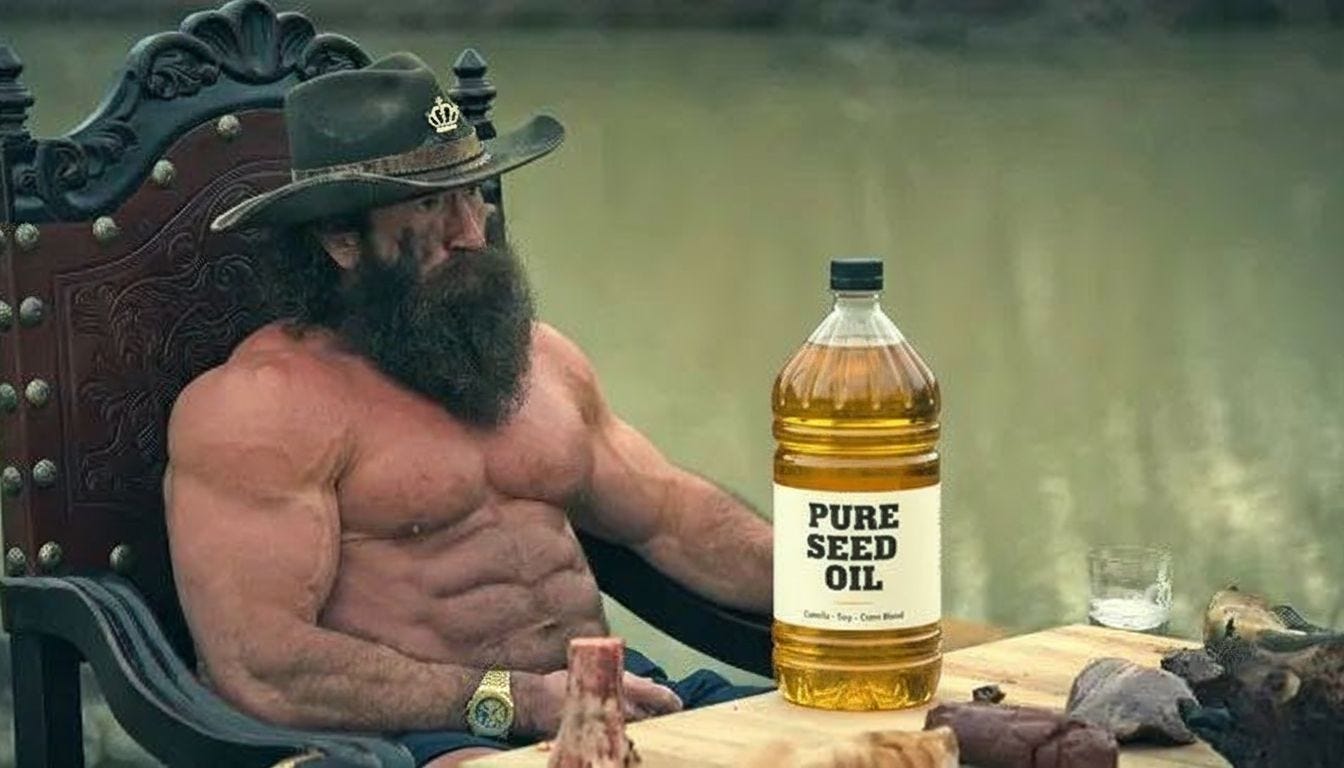
But, I do want you to visualize this: you are behind the McDonald’s, Arby’s, Burger King, or some random Asian restaurant, and there is a big ole container of oil slop.
It smells disgusting, looks disgusting, and tastes disgusting.
That, my friend, is seed oils; the pungent-smelling oils that almost every restaurant fries their garbage in.
Don’t let the cute names deceive you.
When I was younger, after looking at a Crisco vegetable oil container, I remember thinking to myself: how do lettuce and tomatoes turn into vegetable oil?
They don’t, that’s how. Vegetable oil is a made-up term, and you’re a dumb kid.
‘But if it’s made from vegetables, it must be healthy!’
I hate to tell you, but if you have been guzzling seed oils, you might wanna cut that out.
The Origins Of Seed Oil
Cottonseeds, before the industrial revolution, were just another waste product. Good for nothing, but, you guessed it, growing cotton plants.
At the end of the 1800s, America was undergoing heavy industrialization. Electricity, industrial plants, heavy machinery, and automobiles were all the rage.
Efficiency was the name of the game.
The newly created machinery opened the door to effectively process cottonseeds like never before, separating the hulls from seeds in record time and quantity.
An arduous process done by hand was now easily done by machines.
Cottonseed was a dirt-cheap input, perfect for an industrial age filled with machinery that needed inexpensive materials to keep the cogs turning.
The oil was dark, smelly, and initially used for lamps, lubricants, and soap. Nobody ever thought of putting this in their salad dressing.
Then comes David Wesson, the Godfather of seed oil (what a title). Wesson figured out how to stabilize the oil: removing the color, smell, and taste.
Soon, soap and candle companies began putting this ‘cleaned’ oil in their products; effectively, the first step in introducing seed oils into our everyday lives.
Affected by the high prices and monopoly over tallow and lard, the main fats for soaps, cottonseed became quite an attractive option for soap makers who were looking to reduce their costs.
One such company, Procter & Gamble, would make a massive gamble attempting to save its dying soap and candle business, buying up seed oil manufacturing plants hand over fist.
Procter & Gamble
With this new control over the market, they had all the seed oils a man could ever want. They were the candle, soap, and seed oil mafia!
They reduced their exposure to a cornered market, which had effectively handicapped their business, then took control over a whole other market.
Then electricity destroyed their candle business.
Time for a pivot, again.
Their business was a remnant of an archaic world, one without machines.
Soap and candles? That was the equivalent of owning a print shop at the start of the dotcom era.
Or having any job in the late 2020s, due to AI... ;)
Like good businessmen, they started asking themselves what was next.
They made the right move initially: get as far away from the tallow and lard business, use this new cheap, highly refined oil in their products, and buy up as many cottonseed plants as possible.
But now that their candle business was dying to the light bulb, what were they to do with all this extra seed oil?
Sell it as cooking oil, now that it has been refined, deodorized, and made colorless?
Nope, Americans were still too conditioned to seeing cottonseed oil as a machine lubricant (because that’s what it was). Nobody would put that in their body!
Imagine if WD-40 were made colorless, tasteless, and odorless. Would you eat it?
Now that I say that, I would imagine some would. People were just eating Tide Pods a couple of years ago.
Anyway, what if they could harden the purified oil and make it look like tallow or lard through some new technology called hydrogenation that some German scientist just invented?
What if they could market it as a hip “new alternative to tallow and lard”?
What if they told Americans it was healthier than tallow and lard?
What if they made it cheaper than tallow and lard?
What if they came up with a really effective marketing strategy, because if they didn’t, their company would go under because they blew through wads of cash making themselves the Don of seed oils.
“Adding hydrogen atoms to the fatty acid chain, [the] industrial process transformed liquid cottonseed oil into a solid that resembled lard.”1
“What’s the difference, after all!! Lard and tallow are so last year; it’s not like we ate them for thousands of years! We made a new tallow, it’s SOOO MUCH BETTER and cheaper!”
Now that you have an idea of where seed oils came from, how are they made?
I put together my proven health coaching programs — 10 years of battle-tested protocols distilled into personalized guidance for your unique journey.
Root cause resolution. Personalized protocols. Faith-centered support. One-on-one coaching.
Book your free 20-minute consultation to see if we’re a good fit. Check my website to see my crazy story from suffering to strength.
https://littlewaycoach.com/
So, What Is A Seed Oil?
The process of making industrial seed oils is pretty disgusting.
Firstly, most seed oil-producing plants are subsidized by the government, are of GMO origin, and are sprayed with colossal amounts of pesticides and glyphosate.
Second, plants like corn, cottonseed, canola, and rice bran inherently contain a negligible amount of fat.
To expand on this point, let’s examine an ear of corn vs. an avocado to see how much fat is inherent in corn.
Avocado (per ~100 g, raw)
Calories: ~160 kcal
Total Fat: ~14.6 g
Protein: ~2 g
Carbohydrates: ~8.5 g
Fiber: ~6.7 g
🌽 Corn (per ~100 g, cooked or raw sweet corn)
Calories: ~86–96 kcal
Total Fat: ~1.2–1.5 g
Protein: ~3–3.4 g
Carbohydrates: ~19–21 g
Fiber: ~2–3 g
How can they extract so much oil from corn, which has roughly 1 gram of fat per 100 grams?
Step 1: Apply thousands of pounds of pressure to the seeds via an expeller press. The pressure is so intense that it naturally produces 200-250 degrees of heat.
Step 2: Following the expeller press, two items remain: crude, unrefined oil and leftover “seed cake”. The cake still contains some residual oil.
Step 3: Seed oil cakes are washed with a petroleum-derived solvent, hexane, to extract the remaining oil.
Step 4: The final bit of oil will be bleached and treated at temperatures of 400-500 degrees, which removes smell, color, and remaining impurities.
Step 5: Pour the cleaned, finished product into bottles.
This is how the seed oil industry turns 40-50 ears of corn into 7 tbsp of oil.
The whole process involves such an unworldly amount of mechanical intervention.
The oils inevitably become rancid and oxidized during this process, which is why they are treated with hexane, bleached, and deodorized to avoid the horrific smell and color.
Remember how its made? Well they did an episode on canola oil:
What To Do About It
Seed oils damage the most important part of the cell: the cell membrane.
When you consume dietary fat, it’s broken down into fatty acids.
Those fatty acids can be burned for fuel, stored, or rebuilt into phospholipids, the structural building blocks of your cell membrane.
When you consume seed oils, you are breaking down rancid, oxidized fats and using them to build your cell membranes.
Seed oils are what are called Polyunsaturated Fatty Acids (PUFAs for short). Unlike saturated fat, PUFAs contain multiple double bonds within their fatty acid chain.
These bonds, or kinks, make PUFAs more chemically reactive and more prone to oxidative damage. PUFAs, however, are not inherently bad by nature, contrary to what people may tell you.
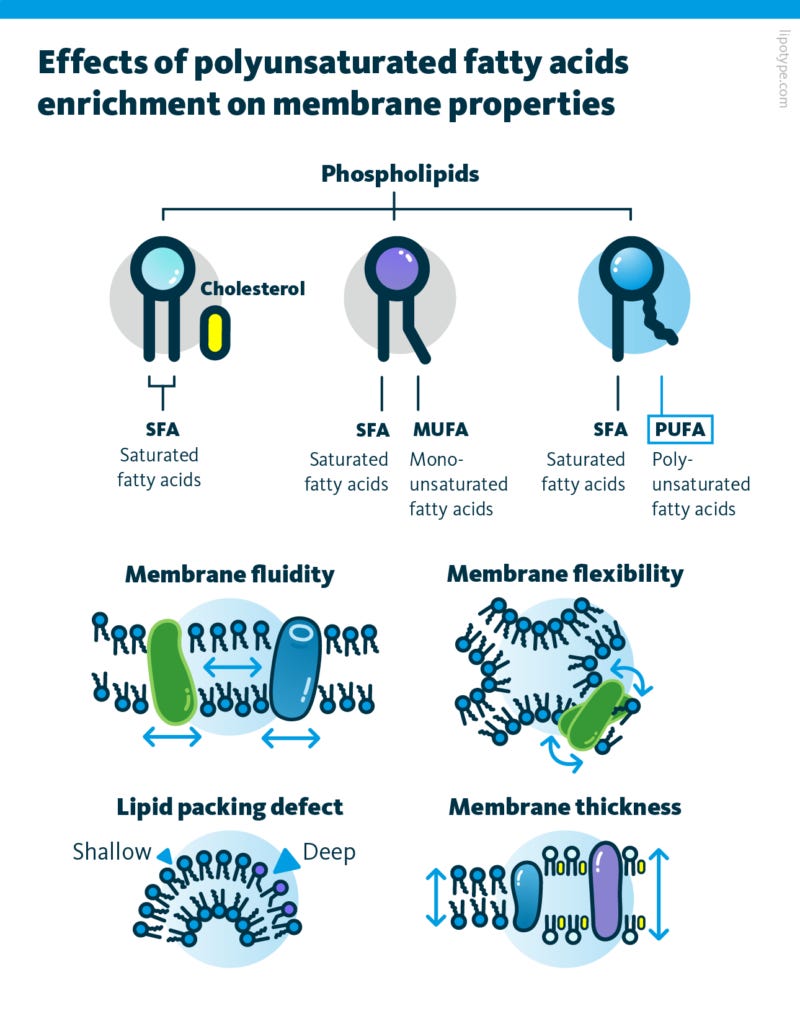
These kinks in the fatty acid chain help your cell membrane with flexibility. Membrane flexibility plays a major role in effective intra- and extracellular communication.
Think of membrane flexibility as how “soft” and moldable the cell’s phospholipid bilayer is, compared to a rigid one.
Flexibility allows membranes to bend, curve, and reshape without tearing. Many important compounds, like fat-soluble vitamins, steroid hormones, and signaling molecules, are fat-soluble. Your cell membranes are made of fat.
The membrane must be able to shuttle these nutrients efficiently without breaking. The more flexible it is, the better it is at this; the more rigid, the worse it is.2
Membranes regulate signaling, nutrient exchange, and provide an overall assessment of the cellular environment around them.
This, in turn, influences signaling pathways that regulate how mitochondrial and nuclear DNA are expressed.
Flexibility also allows the cell to better withstand damage and reorganize itself faster.
So, flexibility is important. There is a perfect harmony between rigidity and flexibility for a membrane.
Think 100% saturated fat cell membrane: a handful of pencils, too stiff.
100% polyunsaturated fats: a handful of straws, too flexible.
Back to seed oils.
Because of the industrial processing, these fats are treated in such a harsh manner, causing damage to the fatty acid chain before ever even entering your body.
Once they are integrated into your cell membranes, they begin drawing reactive oxygen species to that site.
This is what is referred to as lipid peroxidation, where unstable electrons are taken from the cell membrane or given away to unstable oxygen molecules.
To understand oxidation, think of rusting metal. Oxygen molecules react with the metal, causing it to deteriorate over time.
The same process occurs in our cell membranes. The fats found in seed oils are highly reactive, similar to rusting metal, and attract reactive oxygen species (unstable oxygen molecules) to your cell membranes.
When this oxidative reaction occurs, it can damage the phospholipid bilayer that makes up your cell membrane.
Imagine these seed oil fats having a little magnet on them, attracting ferocious little molecules ready to rip anything and everything they encounter apart.
Over the past couple of years, I’ve concluded that all major health issues are related to your cell membrane function.
Seed oils are a major problem for cell membranes, yet there are steps you can take to shield your cells from this horrible damage.
I put together my proven health coaching programs — 10 years of battle-tested protocols distilled into personalized guidance for your unique journey.
Root cause resolution. Personalized protocols. Faith-centered support. One-on-one coaching.
Book your free 20-minute consultation to see if we’re a good fit. Check my website to see my crazy story from suffering to strength.
It can take several years to fully rid the body of toxic PUFA seed oils.
Over the past year, I have put a lot of work into my cell membranes. After struggling with autoimmune issues my whole life, I feel I have finally cracked the code.
So I will just tell you what I did.
Step 1: Stop eating seed oils. I stopped this around 2019 or so.
Step 2: Consume high-quality saturated fats and cholesterol: Raw egg yolks (high in cholesterol and phosphatidylcholine), high-quality beef or lamb, butter, full-fat raw dairy, and raw milk cheeses. Basically, an animal-based diet.
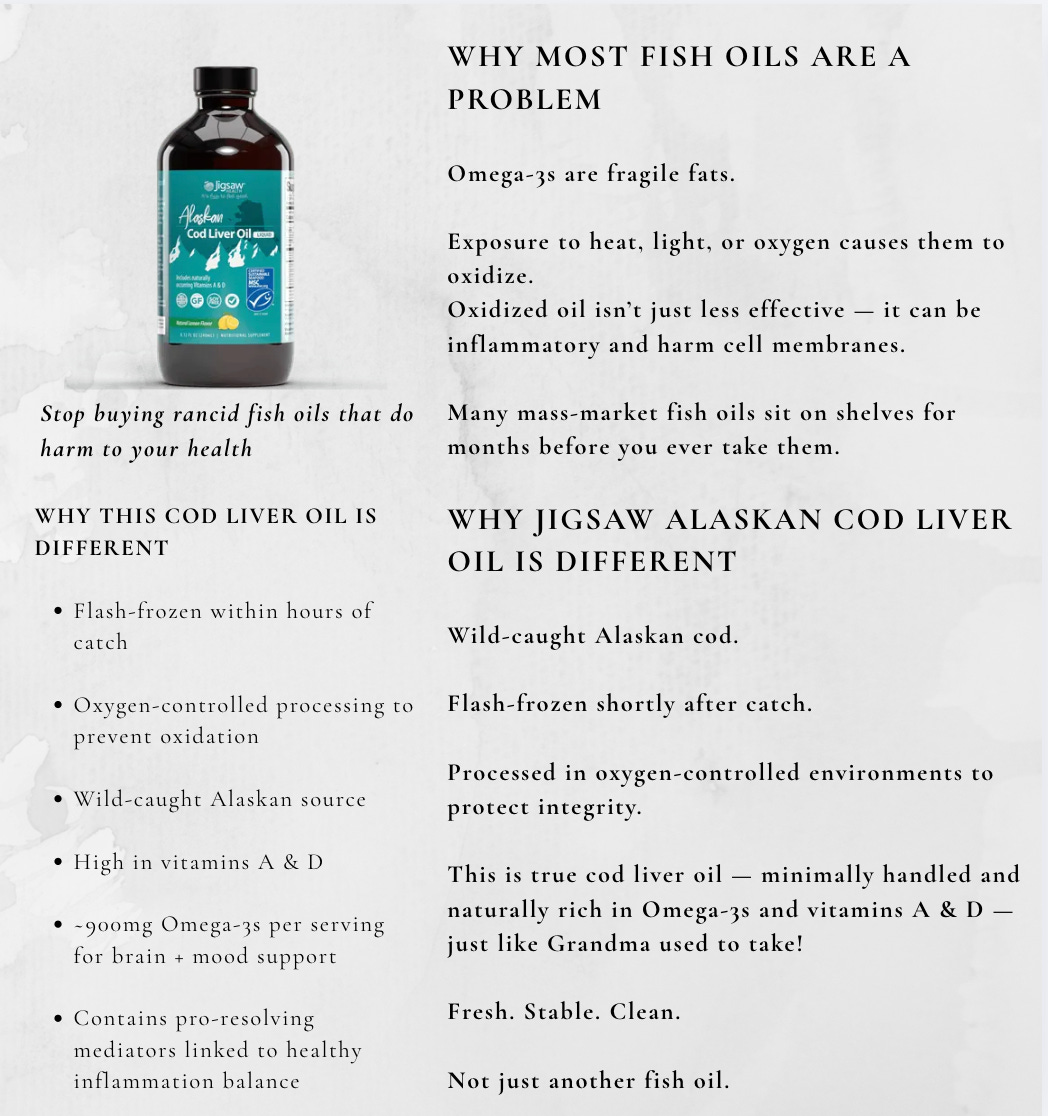
Step 3: Consume very high-quality fish, preferably raw: This one is very important and nuanced. Consuming damaged, low-quality fish or fish oil is a bad idea. Keep in mind that Omega-3 fatty acids are PUFAs and extremely fragile to oxidation. I consume raw oysters, smoked oysters, premium flash frozen fish, and a non-oxidized cod liver oil, NOT FISH OIL. The cod liver oil I consume is flash frozen on the boat and pressed in an oxygen-deprived room. Cod liver oil = olive oil, pressed and squeezed for its oil, and has been an ancient medicine since the Vikings. Fish oil pills = seed oils: factory-made oxidized oils stuffed in a capsule. So if you don’t like seed oils, certainly don’t take Fish oil.
Step 4: I attribute much of my skin healing work to the following cell membrane stack: Vitamin E tocotrienols, high-dose phosphatidylcholine, and high-quality cod liver oil + omega-3 rich foods. PC replaces damaged phospholipids in the cell membrane. Vitamin E tocotrienols, 50x more potent than regular vitamin E, and derived from the annato plant, are a fat-soluble vitamin that embeds in the cell membrane, preventing lipid peroxidation. Omega-3 (DHA) helps the cell membrane be more flexible and ‘smart’, as the DHA organizes in the cell membrane uniquely compared to any other fat.
I am making this infographic for an event, so I thought I would share it here first!
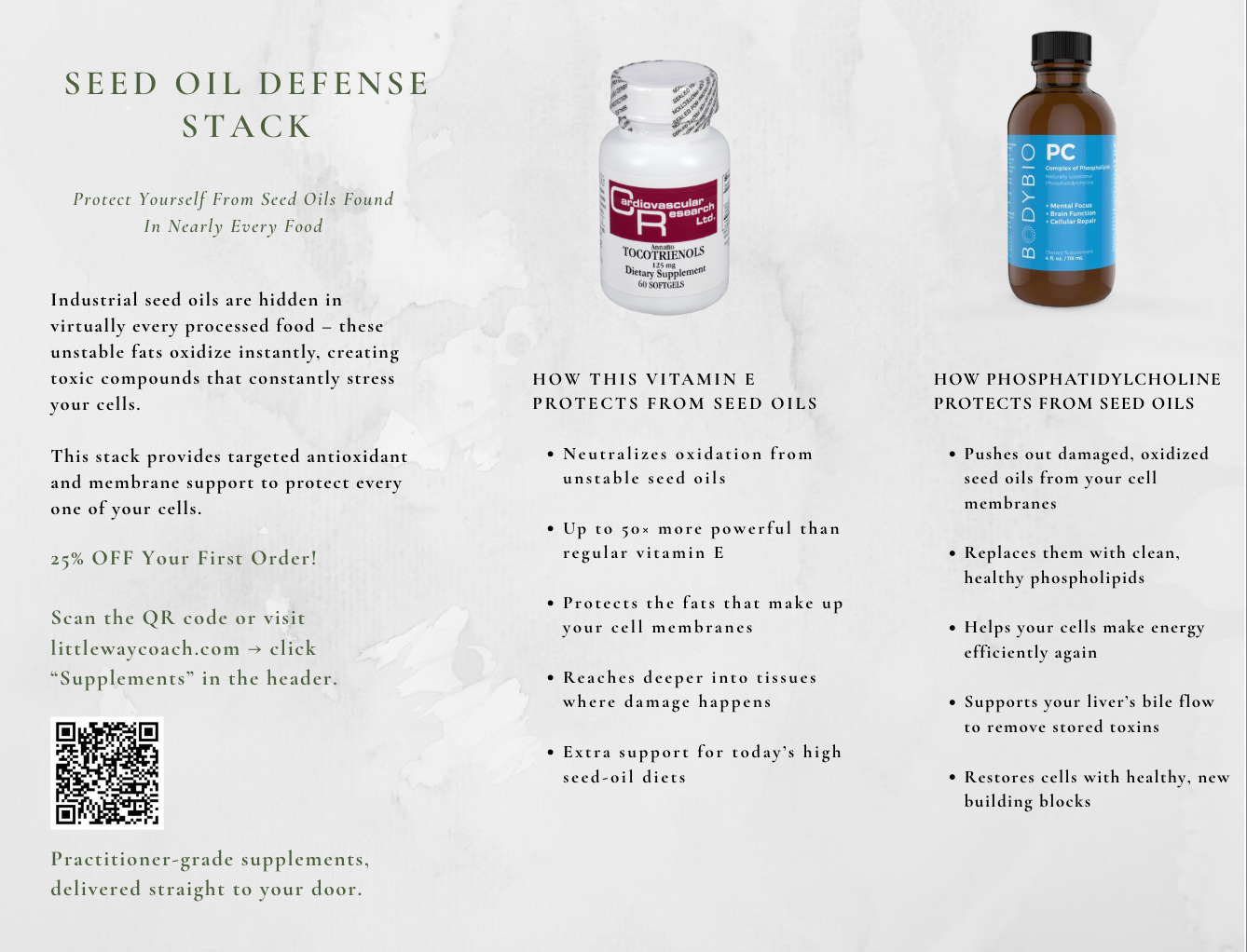
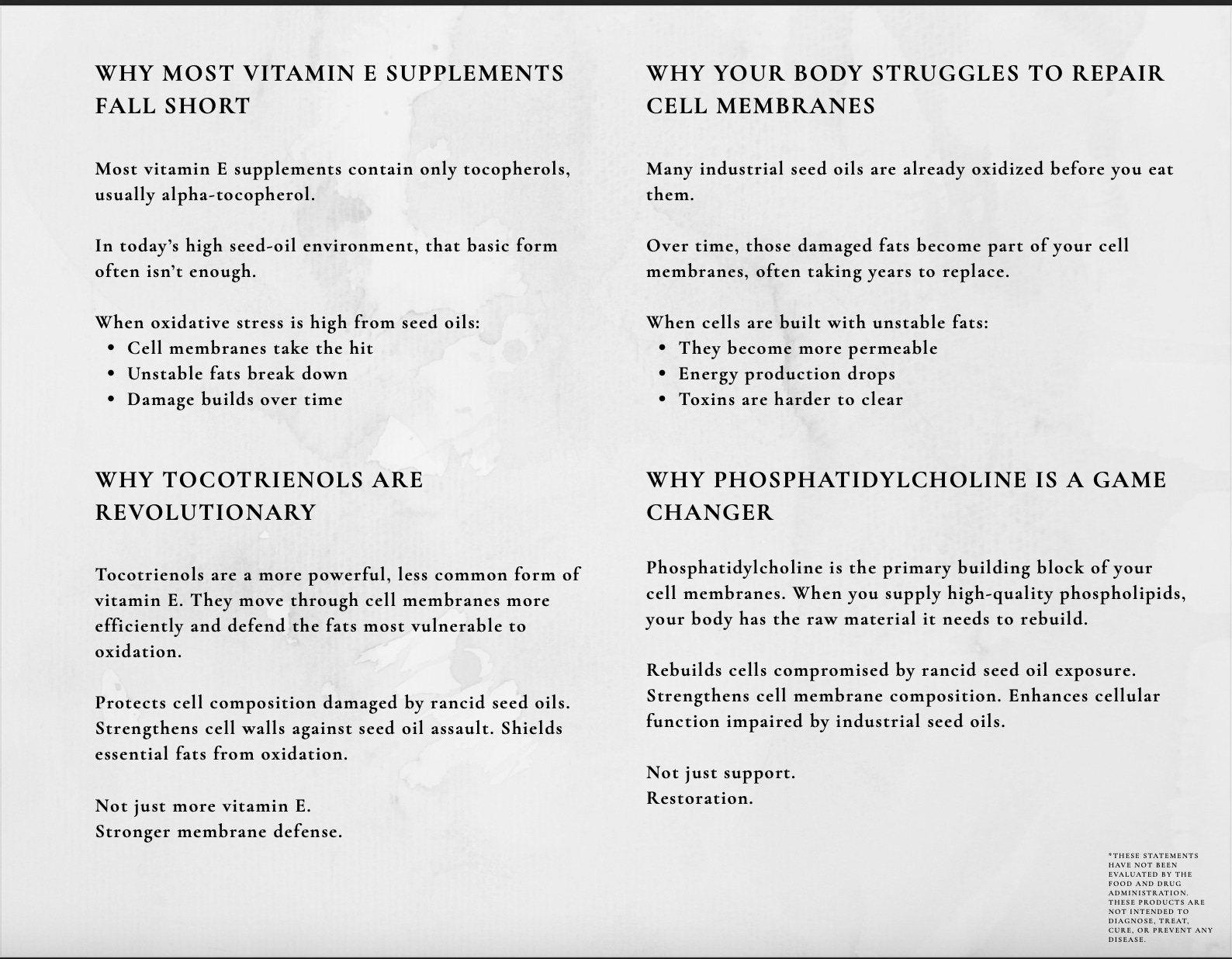
This protocol has really helped me, especially the more I push it. Had I tried this from the start, alongside everything else I was doing, like detoxing from mercury and mold, fasting, keto, etc. I probably would have healed even faster.
But God had a different plan. Now I can share this with people who need help.
This is why I offer health coaching: to help people who are suffering. If you’re tired of endless trial-and-error and want personalized guidance from someone who’s actually walked this path, book your free 20-minute consultation.
Let’s see if I can help you write your own transformation story.
https://littlewaycoach.com/apply

Feel free to check out my Fullscript, the leading supplement supplier for practitioner-grade supplements in the US and Canada! Or visit my website littlewaycoach.com/store!
Till next time,
Scott
Disclaimer: This content is for informational purposes only and should not be considered medical advice. All opinions expressed are my own and not intended to replace professional medical guidance.
https://www.westonaprice.org/health-topics/modern-foods/the-rise-and-fall-of-crisco/#gsc.tab=0
https://www.sciencedirect.com/science/article/pii/S0022227524001020?__cf_chl_tk=.kBr0CuupnwZisL_zt8084R8vQx1T.3YwfSIKEDB3XA-1772538387-1.0.1.1-s0n1DjEEyz6_Rtd7UojJsfQrXf3_YJZZjS1nbsPZM60
I just had a glass of raw milk. The good stuff tastes even better than a vanilla milkshake.
I was interested in looking at your fullscript but it asks for email before I can see the list. Sorry but not going to give my email like before I can see what it is. Is there another way?
I have been looking for a better source of cod liver oil. I was using Nordic Naturals and Carlson but neither tasted quite right so I stopped completely.
my cells read this and filed a formal complaint