


Disclaimer: This content is for informational purposes only and should not be considered medical advice. All opinions expressed are my own and not intended to replace professional medical guidance.
I am a supplement junky. I love experimenting, trying new things, building protocols, and finding the correct tool for the problem.
After several years of doing exactly that, I’ve landed on my favorite supplement of all time: phosphatidylcholine (PC).
PC isn’t just another supplement. It’s the literal building block of one of the most important parts of the cell: the cell membrane.
I’ve written about cell membranes before in my heavy metal piece, but over the past year I’ve become obsessed with them, especially after formulating my own cell membrane protocol and having great success with it.
So today, let’s talk membranes and PC!
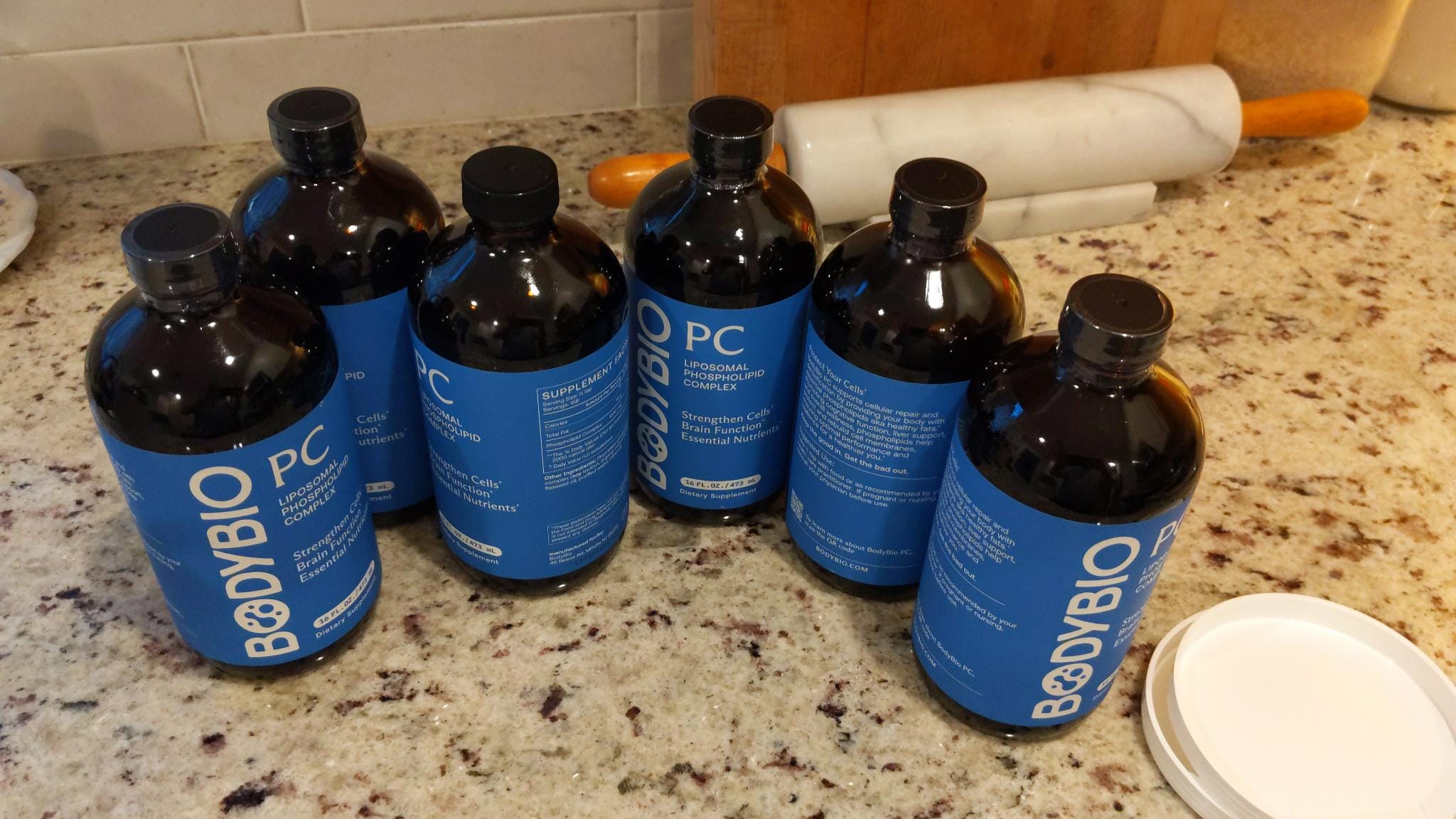
I put my money where my mouth is!!
Why Your Membranes Are Under Attack
We are living in the most toxic environment in human history. Glyphosate. Heavy metals. Mold. Car exhaust fumes. Plastics. Endocrine disruptors. Chemicals that didn’t exist 100 years ago are now part of our daily exposure.
And almost all of these toxins share one thing in common: they end up wrecking our cell membranes and consequently, our cellular health.
Cell membranes are made of fats, and toxins are lipophilic, meaning they love fat. This is why so many obese people have loads of toxins1.
Since our membranes are composed of fat, toxins seek them out and weasel their way in.
Over time, this disrupts membrane structure and creates what’s referred to as “leaky membranes.”
When membranes are compromised:
Hormone receptors malfunction (they live on the membrane)
Mitochondria leak electrons and ATP → energy crashes
Cellular inflammation skyrockets
Detox pathways slow or shut down
Toxins accumulate instead of being eliminated
DNA and RNA damage increases
And this is where most people completely miss the plot with health.
As Dr. Daniel Pompa says, “The health of the cell starts at the membrane.”
Thinking about PC? Don’t settle for mystery supplements.
Join my Fullscript plan and grab 25% off your first order — practitioner‑grade, GMP-certified, lab-tested supplements from Fullscript, the leading platform for trusted practitioner-quality products.
Sign up through the link below and go straight to my PC protocol — no detours, no guesswork.
https://us.fullscript.com/plans/sklein1767385193-the-cell-defense-plan
What Do Cell Membranes Actually Do?
They are not just walls.
A healthy cell membrane is the interface between your internal cellular components and the external world you live in.
How the membrane reads the outside environment drastically affects which genes are turned on or off inside the cell.
The membrane is constantly asking:
Are there nutrients available?
Is this a safe environment?
Are there toxins present?
This is epigenetics in a nutshell.
When the membrane senses a clean environment and abundant nutrients:
Growth genes turn on
Repair pathways activate
Detoxification ramps up
Hormones signal properly
When the membrane senses toxicity and danger:
The cell shifts into survival mode
Growth and repair shut down
Detox pathways stall
Inflammation increases
Gene expression becomes defensive, not regenerative
This makes sense intuitively. If the membrane decides what comes in and out of the cell, don’t you think that’s going to have a profound effect on gene expression?
Crude analogy, but imagine a crappy doggy door. Half the time it lets the dog in, half the time it doesn’t.
A good door lets the dog in, but keeps out burglars, raccoons, and whatever else you don’t want inside.
Membranes on membranes?
If you have read any of my content, you know how important I think mitochondria are for optimal health.
Whats crazy, is even the mitochondria has its own specialized membranes, which create a proton gradient used to generate ATP (the energy of our cells).
The mitochondria itself is essentially a highly folded membrane system, designed to output energy.
These little organelles run the show, and even they need healthy phospholipids to create energy!
Thinking about PC? Don’t settle for mystery supplements.
Join my Fullscript plan and grab 25% off your first order — practitioner‑grade, GMP-certified, lab-tested supplements from Fullscript, the leading platform for trusted practitioner-quality products.
Sign up through the link below and go straight to my PC protocol — no detours, no guesswork.
https://us.fullscript.com/plans/sklein1767385193-the-cell-defense-plan
How Phosphatidylcholine Repairs and Protects
Getting to the point, this is why I really LIKE phosphatidylcholine.
When membranes are contaminated with damaged, oxidized fats and toxins, PC supplies the body with clean, functional phospholipids.
Its the building block needed for a healthy membrane.
The repair process looks like this:
PC integrates directly into existing cell membranes
Damaged phospholipids are gradually replaced
Membrane fluidity, integrity, and signaling improve
Detox signaling turns back on
This can take a while though…
True membrane repair takes 6–9 months of consistent use, after all, we have trillions of cells.
Summary
Discovering phosphatidylcholine has been a game-changer for me. With our bodies constantly exposed to toxins, it’s no wonder that supporting cell membranes can have such a dramatic effect on cellular health.
This article barely scratches the surface of what cell membranes do, or what PC can do for them, but it’s a starting point. If you want to support your cells at the most fundamental level, membrane health is where it begins.
https://pmc.ncbi.nlm.nih.gov/articles/PMC6101675/
This is a fun read and a useful reminder that “membrane health” isn’t woo; phosphatidylcholine really is a major structural phospholipid in cell membranes and lipoproteins, and the liver’s PC supply is tightly tied to VLDL export, bile composition, and lipid handling. That makes the “PC as a liver-adjacent lever” biologically plausible, especially in metabolic dysfunction contexts. 
A couple clinician-scientist nuances that I think actually strengthen your thesis (without dulling the enthusiasm):
1. “Membrane repair” is a real concept, but it’s not magic detox. PC can support membrane composition/turnover and bile/lipoprotein pathways, but “pulling toxins off DNA” is the kind of wording that can outrun the evidence fast. Better frame: supporting hepatic phospholipid pools that influence lipid trafficking + inflammatory tone. 
2. The human evidence base is most coherent for liver-related endpoints (e.g., NAFLD/MASLD adjunct data); promising signals, but still not the kind of large, definitive RCT evidence people sometimes assume from supplement discourse. 
3. Practical guardrail worth mentioning for readers: PC is also a choline source, and people vary a lot in downstream metabolism (including TMA/TMAO pathways). That’s not a reason to fear it, but it is a reason to avoid “more is always better” dosing and to treat it as an N-of-1 with labs if someone is using it therapeutically. 
I like the core message “cells are built, not wished into health” and PC is a legitimate “building block” conversation. If you keep anchoring the claims to specific physiology (liver lipid export, bile, membrane composition) and avoid the detox superlatives, this becomes exactly the kind of biohacking content that’s empowering and scientifically defensible.