


The gut is an ever changing landscape. Gut health issues are on the rise, and frankly probably the #1 symptom clients have when they come to me.
Constipation, watery stools, reflux, poor digestion of fats and proteins (might I say poor time digesting anything) and bloating are among the most common issues.
Many of these symptoms arise from clients who were living in mold, eating conventional diets laced with glyphosate, have a mouth full of mercury amalgam filings, or eating late into the night while staring at their blue-lit screen.
The gut keeps score, and it’s almost always the leading indicator of a crappy terrain. Your gut isn’t just naturally messed up; you weren’t just born with “IBS.”
Depending on what your trigger is, you might need a different approach for fixing your gut. If you’re living in a moldy home and your gut’s cooked, you might want to remove the mold from your home and body before running 6 million different gut protocols and wondering why you’re not making progress.
Irrespective of what your trigger is, it’s still important to follow a framework for remedying your gut issues, as the order truly does matter.
This post will be a little bit on the shorter side and focused on what the research tells us about circadian rhythm and gut health, enjoy!
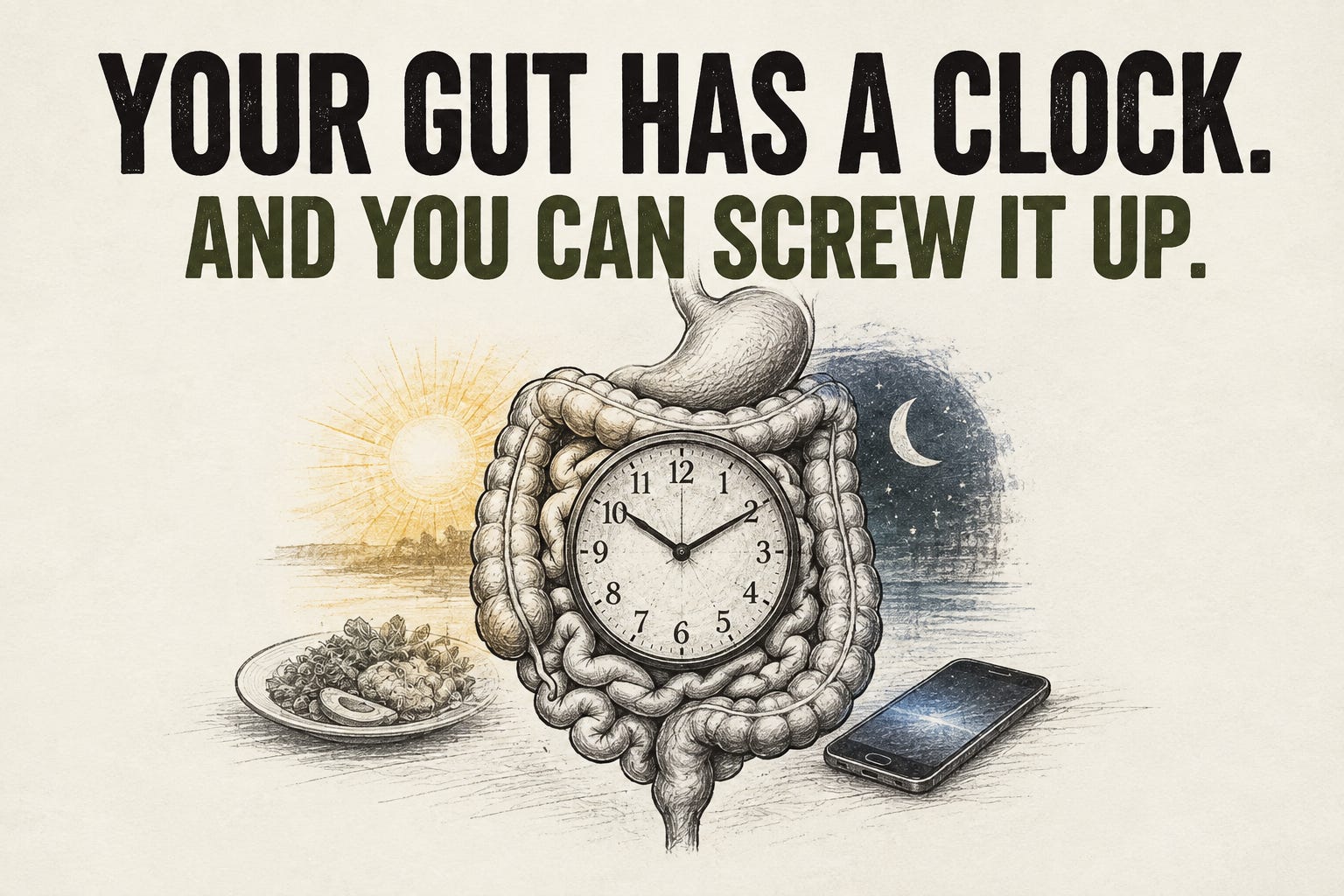
Gut Motility
Gut motility is the coordinated muscle contraction that moves food and waste through your GI tract. It’s driven by peristalsis and run by your enteric nervous system, often called the “second brain,” and carries 400 to 600 million neurons itself!
This process is governed by a clock.
One of the first things I ask clients is when and how often they are going #2. Most of my clients, because they are coming to me with issues, are all over the place and rarely exhibit the ideal bowel movement within 30 minutes of waking. The further people are from this ideal, the more issues they typically have.
For example, the end of the spectrum is going #2 in the middle of the night, while the less extreme, but still bad, is having their first bowel movement around dinner, or maybe around lunch, which is also not ideal.
These patterns can tell you how aligned your body clock is, or how far off-kilter it is.
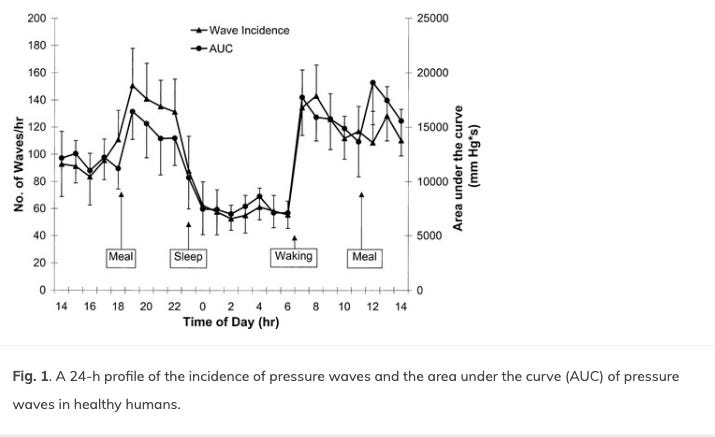
A study on colonic motor patterns communicated this ideal in healthy patients: the colon closes up shop at night, waking triples its activity, and meals double its activity, both of which are strong signals to move stool out and create a bowel movement (figure below).1
Meanwhile, when researchers purposely flipped this clock on its head with mice, shifting their light/dark cycle 6 hours every 3 days for 8 weeks, the mice started getting gut issues.
Food was rushed through, resulting in looser, wetter stool, and a gut more sensitive to pain (or what Ben Greenfield calls a princess gut).
When they peered into the gut wall, the enteric nervous system had been rewired.
Stem cells that build that system were turning into the wrong cells. The master inflammatory switch, NF-κB, had been switched on. The clock gene regulating much of this, NR1D1, had been turned off.2

In reality, these studies just communicate common sense. Anecdotally, when I dealt with Crohn’s, my hardest time was first thing in the morning, because my colonic activity was at its highest. Yet I know I was not giving my body the right cues, as I would stare into my blue-light iPhone before bed and into the middle of the night.
If you can capture an ideal around gut motility, picture this: wake up every morning and get sunshine in your eyes, even if it’s cloudy, to create the strongest waking response for your colon, then eat breakfast as soon as you can. Doing this routinely should normalize WHEN you go the bathroom.
Migrating Motor Complex
The migrating motor complex (MMC) is your gut’s housekeeper. Between meals, your stomach and small intestine run a repeating wave of contractions that sweeps leftover food, bacteria, and debris out.
It cycles every 90 to 120 minutes while you’re fasting, in four phases:
Phase I: Little to no contraction
Phase II: Irregular, low-level contractions
Phase III: the main event, a short, powerful burst of coordinated contractions that starts in the lower stomach or upper small intestine and migrates down the gut, sweeping everything ahead of it
Phase IV: a brief wind-down
The second you snack on another Pop-Tart (yeah I am looking at you), the MMC shuts off, and you send your cleaning crew home.
Your MMC runs on a clock too. Hormones like motilin, a hormone made in the duodenum and jejunum of the small intestine, and ghrelin, your hunger hormone, help trigger it, and both are tied to your daily circadian rhythm.3
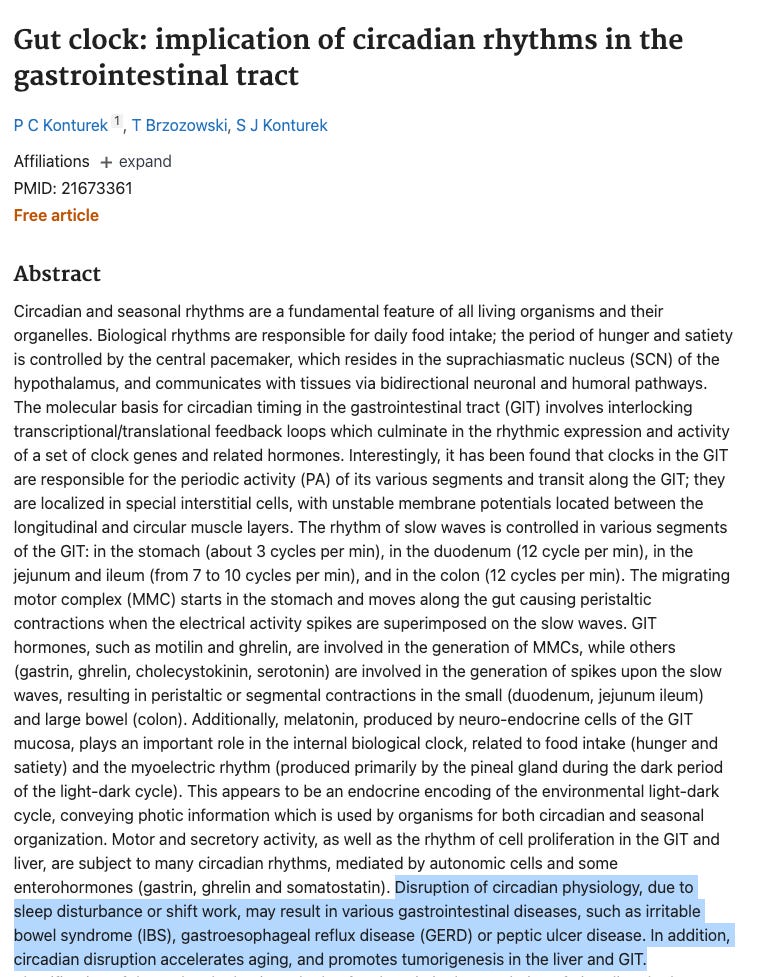
The MMC travels less than half as fast at night as during the day. Using pressure-sensitive pills that measured small bowel motility in patients, researchers saw the pill travel around 6.4 cm per minute by day; at night, it slowed to 2.9 cm per minute.
They observed the same pattern in pigs and sheep, even when the animals were fed at night. Irrespective of the food content in your gut, your MMC sweeps debris harder during the day than at night.4
From constantly eating, eating at the wrong time, and having a skewed gut clock, you can think about what happens to your gut when you never get a proper sweeping.
Gut Lining
Everyone knows leaky gut in the big 26: the process of gut barrier function breaking down, leading to systemic inflammation and immune activation.
Many things in our environment can lead to leaky gut, including poor circadian rhythm. Researchers who scrambled the circadian rhythms of mice found higher levels of intestinal permeability.

The same study noted the downstream problem for shift workers: a leaky barrier lets bacterial endotoxin cross the gut wall into circulation, and the researchers tied that process to the “metabolic, hepatic, cardiovascular and neurodegenerative diseases” commonly reported in shift workers.5
Shift Work and IBS
IBS is an extremely common nothing-burger diagnosis; it basically is given out when your gut’s messed up and doctors don’t know why. In actuality, it’s a combination of issues like SIBO/dysbiosis and the other issues we have discussed here.
If you’ve been sick for years, tried everything, and still have no answers, that’s exactly who I work with.
Come read my story, see if it sounds familiar, and book a free consult. It costs you nothing but 20 minutes. Visit littlewaycoach.com to book your consult!

A study examining IBS prevalence with night shift vs. day shift nurses laid out some pretty clear results. Of 399 nurses, rotating shift workers had IBS 48% of the time compared to 31% of day shift nurses. That held up even after correcting for age, gender, and sleep quality, leading the authors to conclude that circadian rhythm disturbances “may have a function in the pathogenesis of IBS and abdominal pain.”6
Something else to consider is the horrific light environment nurses work in: 5000 Kelvin blue dominant lighting systems that simulate constant, perpetual noon-day sun (more on this in the next section)
Microbiome Composition
Your microbiome lives on a clock, and its composition shifts depending on the time of day. Researchers conveyed this when they ablated the internal clocks of mice and when they looked at the microbiomes of jet-lagged humans; both showed dysbiosis.
When stool from those jet-lagged travelers was placed into mice with no microbiome of their own (called germ-free mice), the mice became obese and glucose intolerant, effectively proving the negative shift of the microbiome caused by poor circadian rhythm.7
Furthermore, in mice, blue light at night has been linked to a drop in microbial diversity and a shift in the balance of good to bad bacteria. What’s crazy is that shift tracks directly with higher cholesterol.
Beneficial bugs like Lactobacillus and Bifidobacterium produce enzymes in the colon that strip bile acids apart so they can’t be recycled back to the liver. They leave in your stool instead, and the liver has to pull more cholesterol out of your blood to make more bile. Without those bacteria, bile gets recycled, and cholesterol rises.8
Gut Melatonin
The gut holds at least 400 times more melatonin than the pineal gland.9
Melatonin has been studied in the context of inflammatory bowel disease, and research findings suggest that melatonin may help colitis “by regulating gut microbiota, modulating antimicrobial peptide secretion, and reinforcing intestinal epithelial barrier integrity.”10
Conclusion
Motility, your cleaning crew, the gut lining, bile, your microbiome, are all dependent on your circadian rhythm; it truly touches every aspect.
This is why setting your clock is step one in my coaching program. You can run the best gut protocol on earth, but if you’re eating at 11 p.m. under some nasty blue LED lights, you’re probably not gonna make the progress you hoped for.
Get some sunlight in your eyes when you wake up, eat breakfast, stop snacking on junk, wear some blue blockers at night, and use blackout curtains at night. Your barrier to entry is almost nothing, there is no excuse!
I battled severe Crohn's for 10 years, so if your gut is a mess and you don't know what's triggering it, that's exactly the work I do with clients. Visit my site littlewaycoach.com to book a free 20 minute consult!
Till next time,
Scott
This article is for educational purposes only and is not medical advice. I am a health coach, not a physician, and nothing here is intended to diagnose, treat, cure, or prevent any disease. Always work with a qualified healthcare provider before making changes to your health protocol, especially if you are taking medications or managing a diagnosed condition.
https://journals.physiology.org/doi/full/10.1152/ajpgi.2001.280.4.G629
https://pmc.ncbi.nlm.nih.gov/articles/PMC11520590/
https://pubmed.ncbi.nlm.nih.gov/21673361/
https://pubmed.ncbi.nlm.nih.gov/3743969/
https://pubmed.ncbi.nlm.nih.gov/23825629/
https://pubmed.ncbi.nlm.nih.gov/20160712/
https://pubmed.ncbi.nlm.nih.gov/25417104/
https://pubmed.ncbi.nlm.nih.gov/38259967/
https://pubmed.ncbi.nlm.nih.gov/12395907/
https://pubmed.ncbi.nlm.nih.gov/42164500/